For businesses nowadays, keeping up with quotes, contracts, billing, renewals, and revenue reporting in different systems means delays, mistakes, and lost revenue.
Salesforce Revenue Cloud helps to solve this challenge by connecting the whole revenue journey in one single platform. From pricing and quoting to billing and revenue recognition, it enables organisations to handle every stage in an organised and automated manner.
Through Revenue lifecycle automation in Salesforce, companies can limit manual work, increase accuracy, and get a clear picture of their financial operations. This approach helps businesses to manage their complex revenue processes without putting undue pressure on their operations.
Understanding Salesforce Revenue Cloud
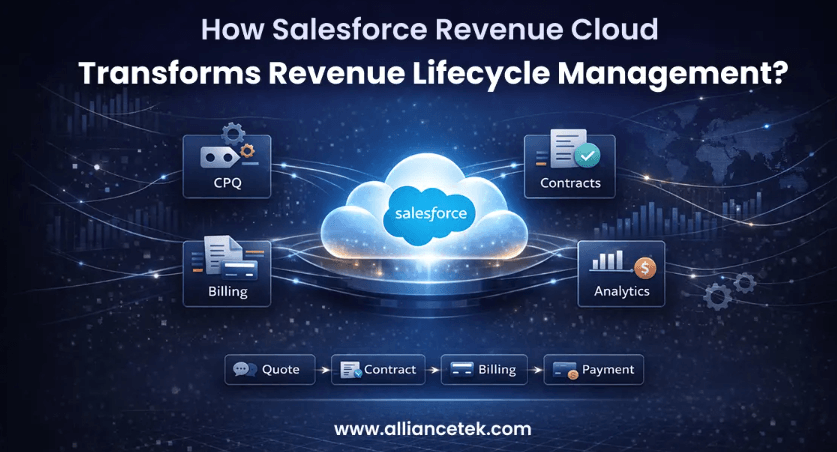
Salesforce Revenue Cloud is an end-to-end solution to manage the entire revenue lifecycle. It is a combination of several tools that assist businesses in managing pricing, contracts, billing, and financial reporting in a single environment.
Key capabilities include:
- Configure, Price, Quote (CPQ)
- Subscription management
- Automated billing
- Contract lifecycle management
- Revenue recognition
- Revenue forecasting
When these capabilities work together, organizations can manage the entire revenue process from one system. This unified structure helps enhance coordination between the sales and finance teams.
Many organizations are turning to Salesforce CRM development services to develop a robust Revenue Cloud foundation and make sure that it integrates seamlessly with their existing Salesforce environment.
Automating Configure, Price, Quote (CPQ) for Faster Sales Cycles
Creating accurate quotes is often one of the most time-consuming parts of the sales process. Creating accurate quotes can be one of the most time-consuming aspects of the sales process. Complex product catalogs, pricing rules and discount structures can be a drag for sales teams.
Salesforce Revenue Cloud makes this process easy using automated CPQ tools. With Salesforce CPQ and Billing integration, companies can create accurate quotes quickly without compromising on pricing.
Key benefits include:
- Automated product configuration
- Instant calculations of pricing
- Approve discount using workflows
- Reduced manual data entry
- Faster quote generation
These technology capabilities enable sales teams to focus their efforts on closing deals instead of managing their spreadsheets or approvals.
Organizations often engage with a Salesforce development company to customize CPQ workflows based on their product offerings and pricing strategies.
Streamlining Subscription and Usage-Based Models
Subscription and usage-based pricing models are becoming the norm in various industries. However, it can be difficult to manage these models when they are handled manually.
Salesforce Revenue Cloud enables businesses to manage recurring revenue effectively by supporting:
- Recurring billing cycles
- Subscription Plans (upgrading/downgrading)
- Usage-based pricing models
- Automated processes of renewal
- Mid-contract pricing adjustments
These features enable companies to keep accurate billing and enhance customer retention.
To put in place flexible subscription systems, many organizations rely on Salesforce CRM development solutions that customize Revenue Cloud capabilities to their business model.
Seamless Quote-to-Cash Automation
The process of moving from closing a deal to collecting payment can involve several departments and systems. Without proper automation, this process can cause delays and administrative overhead.
Revenue Cloud has solved this with the Quote-to-Cash process in Salesforce, which ties everything together after a deal is closed.
After a deal is closed, the platform can automatically:
- Generate contracts
- Create billing schedules
- Produce invoices
- Track payments
- Recognize revenue according to accounting standards
These automated steps help reduce manual handoffs from one team to another and help to maintain consistent financial records.
Businesses implementing these types of workflows often depend on Salesforce Application Development Services to create integrations between Revenue Cloud and their accounting or ERP systems.
To create reporting dashboards that align with business objectives, companies will often turn to Salesforce consulting services for help with data structures and reporting models.
Improving Compliance and Revenue Recognition
Revenue recognition standards like ASC 606 and IFRS 15 are stringent and require companies to be careful about tracking revenue and to report it accurately. Managing compliance by hand can be both time-consuming and risky.
Salesforce Revenue Cloud automates a number of compliance-related tasks, including:
- Mapping revenue to Contract Obligations
- Handling of contract amendments
- Tracking deferred revenue
- Producing financial reports for auditing
Automation helps in reducing errors and making finance transparent.
Many organizations use Salesforce customization services to have Revenue Cloud conform to their accounting rules and regulatory requirements.
See also: Advantages of Decentralized Technology
Driving Cross-Department Collaboration
Revenue operations are multi-team operations. Sales teams will create deals, finance teams will take care of billing, and legal teams will take care of contracts. When every department has different tools, it is difficult for them to collaborate.
Salesforce Revenue Cloud makes departments connected in a common platform. Customer data, contracts, and billing details are still accessible to every relevant team.
In order to maintain and extend these integrations, many companies hire Salesforce developers who can develop integrations between Revenue Cloud and other internal systems.
Some businesses also opt to hire dedicated Salesforce developer resources that work on the same thing, the maintenance and improvement of their revenue management platform.
Supporting Scalable Global Growth
Expanding into international markets introduces additional complexity to revenue operations. Businesses must manage different currencies, tax rules, and pricing strategies.
Salesforce Revenue Cloud supports global operations by enabling:
- Multi-currency transactions
- Localized pricing strategies
- Multi-entity billing structures
- Global tax compliance
To manage expansion smoothly, companies often plan a structured Salesforce Revenue Cloud implementation that supports both current operations and future growth.
Organizations expanding rapidly may also hire Remote Salesforce developer professionals who can support platform updates across global teams.
As organizations scale, many choose to hire best Salesforce developers who can optimize workflows and maintain system performance.
For larger enterprise environments, companies may also hire top Salesforce developers or hire expert Salesforce developers to manage advanced configurations and integrations.
In highly regulated industries, organizations often prefer to hire certified Salesforce developers who understand both technical implementation and compliance standards.
Businesses seeking strategic guidance may also hire Salesforce consultants to review their revenue processes and identify opportunities for improvement.
Conclusion
Managing revenue today requires a system that connects sales, finance, and operations without unnecessary complexity. Disconnected tools and manual processes make it difficult for businesses to maintain accuracy and efficiency.
Salesforce Revenue Cloud provides a unified platform that simplifies pricing, quoting, billing, and revenue reporting. By automating key processes and improving visibility, organizations can manage revenue with greater confidence.