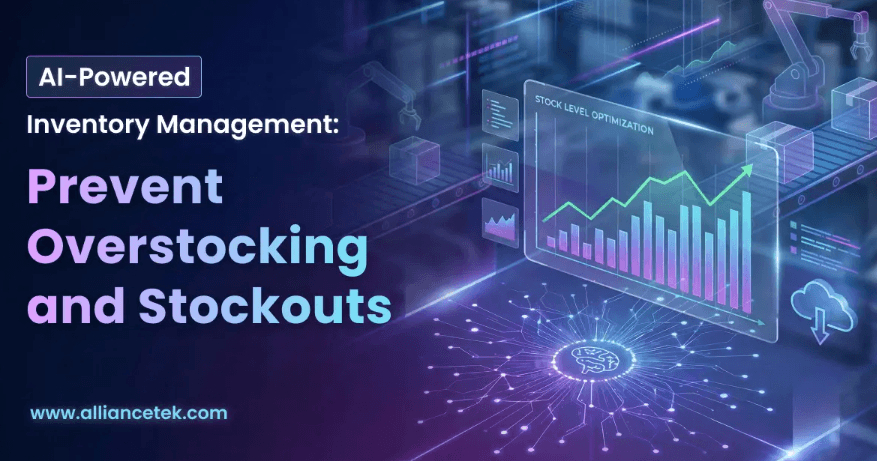
Managing inventory has never been a game of equilibrium. Excessive inventory is a waste of capital, adds storage expenses, and creates obsolescence. Not enough inventory leads to losses in sales and unhappy consumers. Conventional systems, which are based on fixed rules and past averages, find it difficult to match fast-changing demand. This is where AI-inventory management is changing operations.
Fundamentally, AI-powered inventory management employs information, predictive analytics, and automation to optimize stock in real-time. Companies that collaborate with an AI ML development company are able to stop making reactive decisions and start proactive strategies that will decrease inefficiencies and enhance accuracy.
The Limits of Traditional Inventory Systems
Traditional inventory models rely widely on past records and time-consuming forecasting. In steady environments, they are effective, but in a changing environment, such as seasonality, promotion, or disruption, they fail. Planning by humans is usually incapable of handling big, dynamic data.
Using the AI/ML development services, companies can operate systems that constantly accumulate knowledge based on incoming data in real-time, including sales velocity, supplier timelines, or customer behavior. This results in a more responsive and correct planning.
How AI Improves Inventory Decisions
The AI systems process information on a variety of sources such as ERP systems, supply chains, and external indicators. These systems recognize trends and come up with accurate predictions, enabling business organizations to make superior stocking decisions.
Organizations that use AI/ML consulting services usually begin by examining how their inventories move without causing any inefficiency. Based on this, they adopt models that are within operational objectives and constraints.
Automated decision-making is one of the significant advantages of artificial intelligence and machine learning solutions. AI is dynamically able to change reorder points, safety stock, and replenishment cycles, depending on changes in demand.
Reducing Overstocking
Overstocking ties up capital and raises carrying costs. AI solves this by matching procurement with actual consumption patterns as opposed to assumptions.
Custom AI/ML solutions enable companies to develop models that consider the lifecycle of products, regional demand variations, and supplier variations. This can make accurate stocking decisions that do not have surplus stock.
Demand forecasting AI is one of the most influential capabilities that predicts not only the amount of inventory required but also its time. Companies that hire AI developers will be able to apply these models to decrease waste and enhance inventory turnover.
Preventing Stockouts
Understocking results in missed earnings and customer dissatisfaction. AI helps to overcome this risk by constantly tracking inventory and anticipating unavailability before it happens.
Firms hiring a dedicated AI ML developer team can develop systems that can send real-time notifications and automatically replenish. These systems take into consideration supplier delays, logistic constraints, and changing demand trends.
Also, inventory optimization algorithms are used to compute the optimal inventory levels to maintain between safety and reorder stocks to ensure that there is enough inventory without excess stock.
Real-Time Visibility
AI allows real-time performance of inventory. The companies that hire top freelance AI ML developers can design dashboards to monitor the stock status, turnover, and demand patterns in different locations.
This level of visibility allows decision-makers to respond quickly to changes, whether it’s a sudden spike in demand or a disruption in the supply chain. It also enables better collaboration across departments, from procurement to sales.
With real-time inventory tracking, organizations can monitor stock movements across multiple locations, ensuring accurate data and reducing discrepancies.
Strengthening the Supply Chain
AI is not limited to inventory to improve the general resilience of the supply chain. Analysing supplier performance and external risks, AI systems may suggest other sourcing strategies.
Companies that hire remote AI ML developers have an opportunity to develop flexible systems that can adjust to the varying conditions in the supply chain. In such systems, predictive analytics in the supply chain is used to predict delays and make changes in inventory plans in advance.
In order to achieve such abilities successfully, numerous corporations hire AI and ML developers to integrate AI models into their current framework.
See also: Transformational Leadership in Building Resilient, Inclusive Communities
Cost Efficiency and Scalability
The success of AI-powered inventory management depends on the expertise behind it. Companies looking to scale quickly may choose to hire Offshore AI ML developers to access specialized skills at competitive costs.
Others may prioritize quality and experience by choosing to hire the best AI ML Developers who can design robust, production-ready systems tailored to complex business needs.
To ensure seamless implementation, organizations often hire artificial intelligence engineers who understand both the technical and operational aspects of inventory management.
Additionally, businesses benefit from hiring domain-specific experts, such as when they hire machine learning engineers to fine-tune predictive models or hire AI ML programmers to integrate AI capabilities into existing platforms.
Strategic guidance is equally important. Companies that hire AI ML consultants can align their AI initiatives with broader business objectives, ensuring that technology investments deliver tangible value.
Conclusion: The Future of Inventory Management
AI-powered inventory management is no longer a competitive advantage; it’s becoming a necessity. As markets become more volatile and customer expectations continue to rise, businesses need systems that can adapt in real time.
From automated inventory replenishment to intelligent demand forecasting, AI is transforming how organizations manage their inventory. It enables smarter decisions, reduces inefficiencies, and creates a more resilient supply chain.
In a world where precision and agility define success, AI is the key to striking the perfect balance, ensuring you never overstock or understock again.